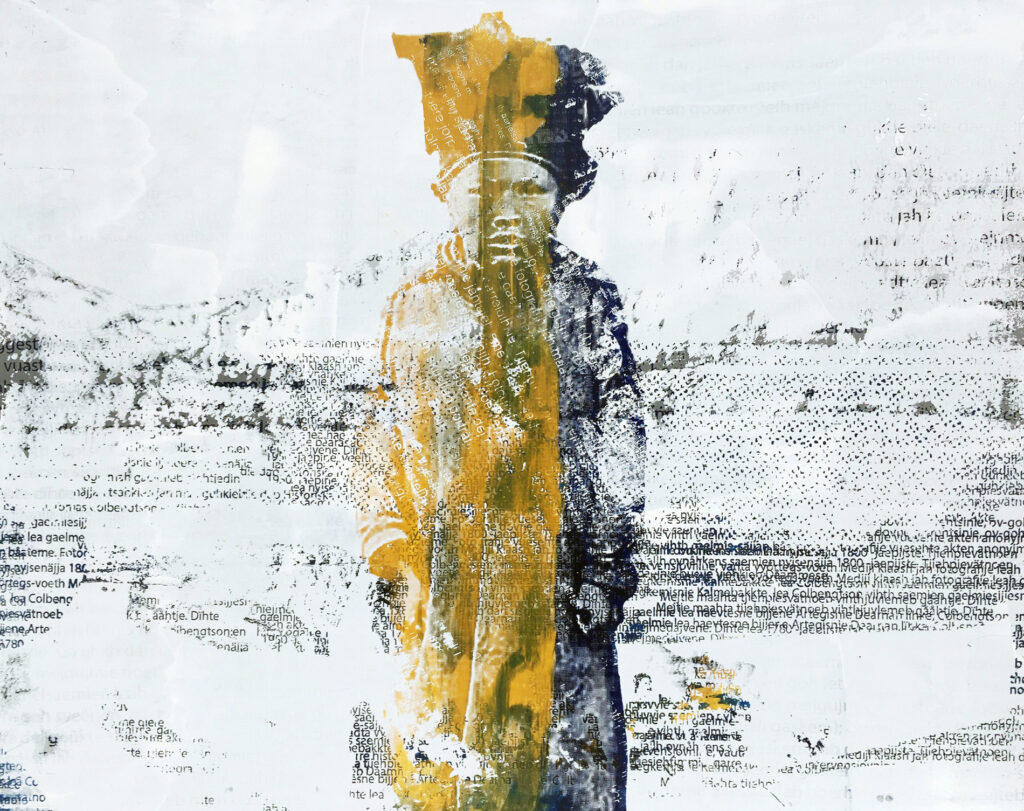
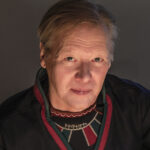
I come from the South Sami region and was born into the Christian faith; my older relatives were deeply religious and knew their favourite Bible verses by heart. At the same time, they still carried rudimentary traces of pre-Christian animistic beliefs, which were never really talked about openly - animism as the belief that the nature we live in is itself made up of living spirits. That we should travel carefully through nature and be careful to use its resources with the least possible intrusion.
We would hunt and fish with care. In the past, it was common to make sacrifices at specific rocks, lakes or mountains where the gods were thought to live. Your whole existence depended on your relationship with the gods, who ensured that the weather, hunting, reindeer herding and fishing were favourable. You could turn to them with specific questions or seek healing and support. The landscape itself - with its animals, rivers and mountains - is at the heart of Sami identity, something that does not disappear even if you have grown up in an urban environment.
The borders drawn by the states therefore became like a knife that cut through the lives of all Sami, whether we lived in Sweden, Norway, Finland or Russia. It was an event that created a trauma that has not yet healed. We have become experts in survival, and at the same time diplomats, to respond to the new initiatives and rules of the authorities. All Sami people have been marginalised in one way or another.
I myself am an example of this, as I have a Norwegian surname from my father's Norwegian Sami origin, while my mother comes from the Swedish South Sami side.
Originally, Sápmi was a cohesive region with no borders, but the borders drawn in 1751 divided families and lands. The closing of the borders in 1919 was a severe blow to the Sámi way of life and reindeer husbandry, as we could no longer move across national borders. This has left lifelong wounds on the Sami people.
Now, in 2020, the coronavirus pandemic has similarly cut off our opportunities to meet, almost like the border closures of 1919. I realise today that the reason I work as an artist is that I was born into this trauma. It became clear to me when I was sitting at my grandfather's old dammed-up boat mooring about twenty years ago. There I suddenly saw, with complete clarity, the total destruction of Sami lives caused by the relentless policies of the Swedish state. The decisions of the authorities have been so devastating that one almost has to ask whether we are even considered human.
All of us in Sápmi bear similar wounds, and the task of art is to make visible the blind spots - and the vast white fields - of our collective consciousness.

 Swedish
  English